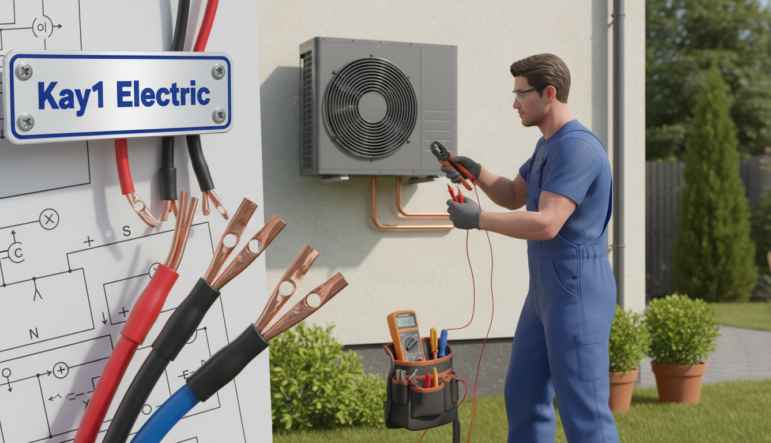
Installing a Heat Pump? Don’t Forget the Electrical Requirements ?
Did you know that nearly 40% of new systems in Canada have wiring or sizing issues that cut efficiency and raise bills?
We see this often: a heat pump installation is not a simple equipment swap. What looks like “good enough” wiring can drive up energy costs, cause frequent service calls, and shorten equipment life.
We set the expectation clearly: this is an electrical and HVAC project, not just a box swap. The right Heat Pump Electrical Connection affects safety, comfort, and long‑term cost for your home or small business.
We explain how wiring ties to how the system runs—start currents, defrost cycles, auxiliary heat, and controls—not just simple power on and off.
In this guide, we preview planning, site prep, safe disconnection, wiring runs, thermostat wiring, and commissioning so you can spot corner‑cutting early.
When in doubt, call a licensed pro. Reach Kay1 Electric LTD at (778) 900-1004 for code‑aligned power and controls in Coquitlam, Vancouver, North Vancouver, and West Vancouver.
Key Takeaways
- Proper wiring is as important as correct equipment sizing for performance.
- The Heat Pump Electrical Connection is a make‑or‑break detail for safety and cost.
- We cover planning, safe disconnection, wiring runs, controls and testing.
- Incorrect installation leads to higher bills and more service visits.
- Call Kay1 Electric LTD at (778) 900-1004 for licensed work in the Lower Mainland.
Why the electrical side of a heat pump install matters for safety, efficiency, and warranty
Poor wiring choices quietly turn a good installation into an expensive problem. Small mistakes at install affect safety and comfort, and they can void warranty coverage if commissioning and documentation are missing.
We explain plainly how loose terminations, undersized conductors, wrong breaker choices, or messy routing show up later as nuisance trips and comfort issues.
How “good enough” wiring raises energy cost and service calls
Corner‑cutting can let a system run now but add thousands to your energy bills over its life. It also shortens component life and creates more service visits during cold snaps and defrost cycles.
Why most installs fail without process, testing, and documentation
Commissioning matters: testing commonly takes 45 minutes to 2+ hours and proves correct operation in heating and cooling. Without torque checks, control verification, and written results, warranties may be at risk.
When to stop and call a licensed pro
Stop and call if you smell burning, see flickering lights on start, get repeated breaker trips, or find no outdoor disconnect or clear panel labelling.
- We link poor workmanship to higher energy use, shortened life, and comfort problems.
- We show that many failures are process issues, not parts.
- For licensed help and coordination with your HVAC team, call Kay1 Electric LTD at (778) 900-1004.
Plan first: home assessment, load calculation, and selecting the right heat pump
A proper assessment upfront sets the stage for reliable year‑round comfort. We start with a formal load calculation (often a Manual J) rather than guessing from square footage.
What a real load study checks:
- Insulation thickness, window and door glazing, and air leakage.
- Floor areas by type (main, basement, crawl space) and ceiling height.
- Occupants, ductwork gaps, and slab vs basement heat loss.
Sizing affects more than comfort. A larger model raises MCA and MOCP requirements, which can force larger breakers or panel upgrades. Oversizing causes short cycles and humidity issues. Undersizing creates longer runtime and stress during cold spells.
| Decision point |
Impact on performance |
Electrical implication |
| Correct sizing |
Stable temperature, efficient heating and cooling |
Balanced MCA/MOCP, standard breaker sizing |
| Oversized unit |
Frequent cycling, poor humidity control |
Higher start currents, possible panel limits |
| Cold‑climate, staged option |
Smoother warmth, reduced auxiliary use |
May need multi‑stage controls; moderate electrical changes |
Choose a model based on comfort goals, noise tolerance, and your panel capacity—not just price.
Planning checkpoint: If the assessment shows limited panel capacity or unclear circuits, pause and call us if planning reveals panel limits at (778) 900-1004 so we can confirm safe options before you order equipment.
Heat Pump Electrical Connection requirements in Canada: what your installer must confirm
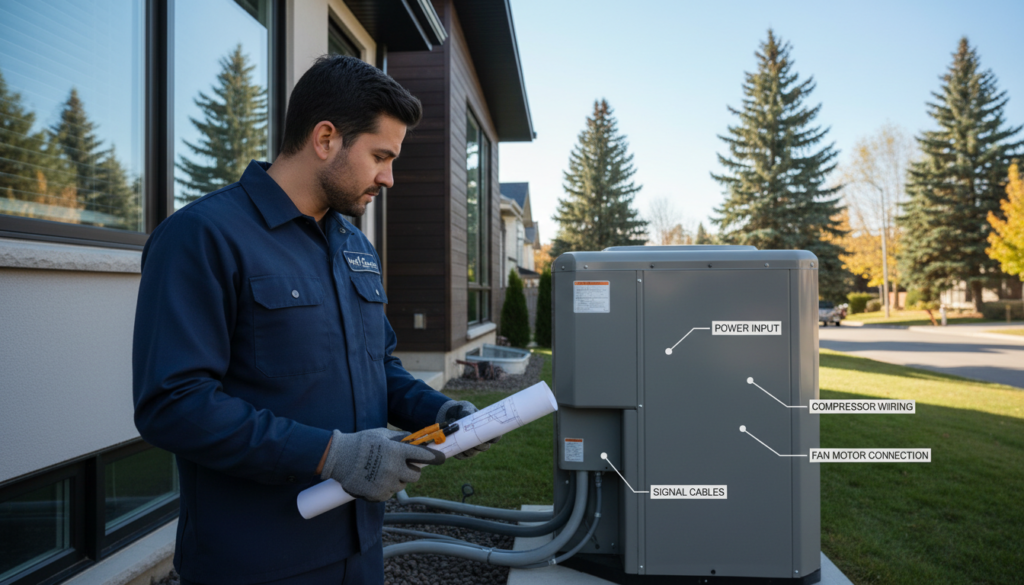
Before any breaker is turned on, your installer must validate the panel and supply capacity for safe operation.
Dedicated circuit needs, panel capacity, and when upgrades are likely
We verify dedicated circuits, available breaker spaces, and total load on the panel. A dedicated circuit means the unit gets its own breaker and does not share with other major loads.
If the panel lacks spare spaces or the supply rating is too low, upgrades are often required to meet local codes and performance requirements.
Disconnect location, accessibility, and why it’s required for new installs
New installs typically include a service disconnect box mounted securely and accessibly near the outdoor unit. Older systems often lack this and must get one to meet safety standards.
The disconnect protects technicians and homeowners by allowing local isolation during service.
High-voltage vs low-voltage connections and what each controls
High-voltage line feeds supply the outdoor unit and sometimes the air handler. Low-voltage control wire handles thermostat signals, staging, and reversing valve logic.
Grounding and protection basics homeowners should recognize
Look for an intact ground conductor, proper fittings, and no exposed copper outdoors. Weather-rated enclosures, strain reliefs, sealed penetrations, and clear circuit labelling are key protection checks.
“A visible, well-labelled disconnect and clean terminations tell you the install meets basic safety requirements.”
| Item |
What to confirm |
Why it matters |
| Panel capacity |
Available spaces, main supply rating |
Prevents overloads and needless upgrades |
| Dedicated circuit |
Own breaker, correct sizing |
Improves reliability and simplifies troubleshooting |
| Disconnect |
Accessible, mounted, weather-rated |
Allows safe local isolation for service |
| Ground & protection |
Continuous ground, sealed entries |
Prevents shocks and moisture damage |
If your installer cannot clearly explain breaker sizing, disconnect placement, or grounding, call Kay1 Electric LTD at (778) 900-1004 for an electrical confirmation in Coquitlam, Vancouver, North Vancouver and West Vancouver.
Preparing the site and power: placement, clearances, and service access
Choosing the right spot for the outdoor unit saves time, lowers wiring complexity, and prevents costly service visits.
We place units where airflow and technician access are easy. Good placement reduces long wiring runs, lowers protection needs, and keeps future service simple.
Outdoor unit location choices that affect wiring runs and maintenance
Long runs increase material and labour time. They often require heavier conduit and extra ground protection. A nearby panel and clear route make service calls faster and cheaper.
Elevation and drainage to prevent snow/ice issues and protect components
Raise the unit above typical snow levels to keep coils clear and allow drainage. A gravel base or composite pad prevents settling on soft ground and reduces stress on systems and wiring.
- Placement priorities: airflow clearance, technician access, noise away from bedrooms, and a direct path for neat conduit to the panel/disconnect.
- Site prep: clean, level area; compact base; durable pad such as composite or crushed rock.
- Homeowner checks: no pooling under the unit, no exposed conduit trip hazards, and clear access to the disconnect for safe service.
“A level pad and raised location cut freeze damage and make routine maintenance predictable.”
| Factor |
What to do |
Why it matters |
| Location |
Near panel; clear conduit route |
Shorter wiring runs; easier service |
| Elevation |
Raised pad above snow line |
Prevents ice build-up and coil damage |
| Base |
Composite pad or gravel |
Stable support; reduces ground shifting |
| Access |
Clearance for technicians |
Simplifies maintenance and reduces time |
If you’re unsure whether the chosen location will raise wiring costs or limit future service, call us for a site‑planning consult at (778) 900-1004. We’ll help plan a clean, code‑minded layout that protects your home and systems.
Replacing an old unit: safe disconnection before any wiring changes
We follow a clear sequence to keep people safe and work efficient: refrigerant recovery first, then power isolation, then removal and replacement. This order prevents anyone from working near energized parts while refrigerant lines are open.
Refrigerant recovery and its impact on the electrical workflow
Refrigerant must be recovered with certified equipment and not vented. Once recovered, technicians can access lines and valves safely.
This step changes the electrical plan: the mechanical team schedules recovery, then electricians plan the shutdown so no live circuits remain during mechanical removal.
Disconnecting the whip and replacing the disconnect for safety
We define the whip as the flexible cable from the outdoor disconnect to the unit. Old, brittle whip assemblies are common failure points and should be replaced during the installation.
- Replace the disconnect and whip as part of a “do it once, do it right” approach.
- Red flags that pause work: missing disconnect, corroded box, brittle insulation, or undocumented splices.
- Insist on a clear handoff between contractors so responsibilities and timing are documented.
“Recover refrigerant first, then cut power—this simple rule protects crews and your home.”
For an electrical safety check during any swap‑out, call Kay1 Electric LTD at (778) 900-1004.
Running and connecting wiring: best practices for clean, code-compliant work
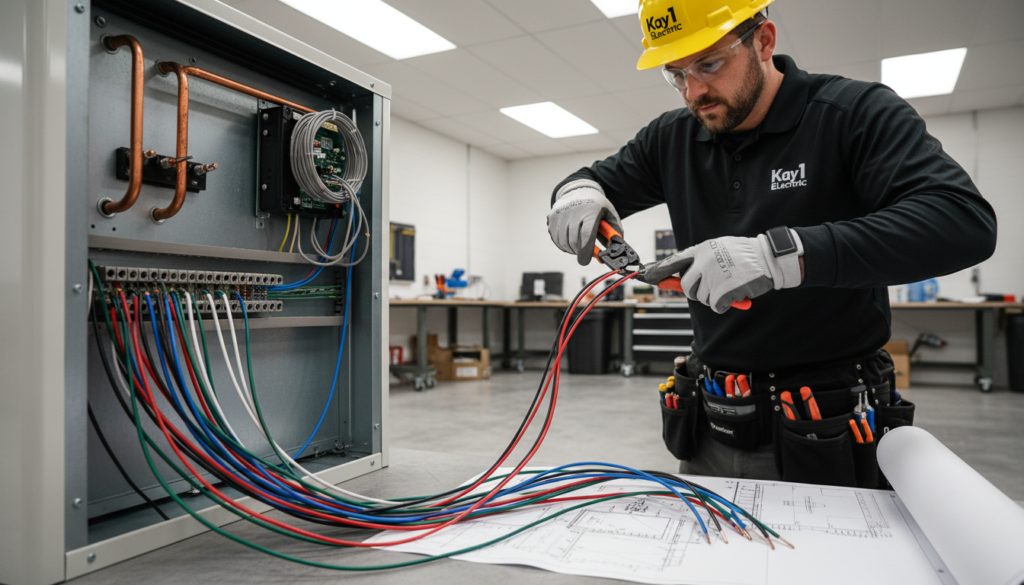
A neat run from the panel to the outdoor disconnect saves time, materials, and headaches later.
High-voltage supply to the outdoor disconnect
Clean, code-compliant work means the supply is routed on a dedicated path from the panel to a securely mounted disconnect. Conductors are sized to manufacturer specs, placed in proper conduit, and given mechanical protection to prevent abrasion and corrosion.
Low-voltage control wire routing
Keep control wire separate from line runs to avoid interference. Protect the bundle from nails, moisture, and crushing. Terminate exactly to the furnace and control boards per the wiring diagram to prevent intermittent faults.
Outdoor sensor, defrost wiring, and terminations
An outdoor sensor often dictates defrost and staging logic for reliable operation. Proper stripping, torque, strain relief, and weatherproofing at outdoor terminations reduce corrosion and nuisance trips.
Trade coordination and homeowner checklist
Electricians handle line circuits, breakers, and the disconnect; HVAC contractors finish control wiring and equipment setup. We advise you ask for labelled circuits, photos of final wiring, and a list of tested functions before crews leave.
“A tidy run and tight terminations are the difference between a job that lasts and one that calls you back.”
Want a licensed team to handle or verify the work in Vancouver and surrounds? Call Kay1 Electric LTD at (778) 900-1004.
Thermostat wiring for heat pumps: terminals, reversing valve, and auxiliary heat
Thermostat wiring is the command centre for your home comfort. We map common terminals and explain what each does so you know what to check before upgrading or swapping a thermostat.
Common terminals and what they do
- R / C — 24V power and common; needed for most smart units.
- Y / Y2 — Compressor stages; you feel this at the vents when cooling or staging starts.
- G — Fan control; turns the blower on for air movement.
- O/B — Reversing valve signal; controls whether the unit runs in heating or cooling mode.
- W2 — Second-stage or auxiliary heat; engages electric strips when needed.
Reversing valve setup: O vs B
Only one of O or B is used because reversing logic differs by manufacturer. If wired wrong, the system will run backwards and you’ll get cooling when you expect warmth.
Emergency heat and heat strips
Emergency heat disables the outdoor unit and forces electric strips. It works in extreme cold or when the outdoor unit fails, but it is costly to run.
Smart thermostat compatibility
Not all smart thermostats support multi-stage reversing valves or auxiliary heat. Confirm support for O/B and 24V common before buying. Typical costs range from $50–$250.
Safety tip: take a clear photo of existing wires before disconnecting. Labels beat guessing every time.
For thermostat verification or rewiring in Metro Vancouver, call Kay1 Electric LTD at (778) 900-1004.
Commissioning and testing: proving safe operation in heating and cooling
Testing confirms the system not only powers on but also operates correctly under real loads. We treat commissioning as the proof phase for a proper installation.
What we test and document
- Thermostat sequence: verifies calls and reversing logic.
- Heating and cooling performance: run each mode 15–20 minutes to get meaningful readings.
- Defrost and emergency stages: confirm initiation, termination, and aux staging.
Why it takes longer than A/C
Commissioning commonly runs 45 minutes to 2+ hours. It is often 15–45 minutes longer than a simple A/C check because multiple modes and controls must be exercised.
Early warning signs homeowners can spot
- Frequent short cycling or uneven temperatures.
- Ice buildup in mild weather or odd vibrations and noises.
- Unexpectedly high energy bills after installation.
If you spot these red flags, stop “living with it” and ask for commissioning records and an electrical and controls review.
Need help with commissioning or verification in Vancouver, Coquitlam, North Vancouver or West Vancouver? Call Kay1 Electric LTD at (778) 900-1004.
Conclusion
Good installations finish with proof: tests, labels, and clear paperwork that show the system meets safety and efficiency goals.
Plan, confirm panel capacity and the outdoor disconnect, run high and low voltage wiring neatly, set thermostat controls, then commission heating, cooling, defrost and emergency stages. Typical install time is 4–8 hours, with commissioning adding focused testing.
Correct sizing and clean wiring cut breakdown risk and lower long‑term cost. Homeowners in the Vancouver area should expect raised pads, weatherproof terminations, and clear labelling for fast service.
Professional means coordinated electricians and HVAC contractors, no guesswork, and testing that proves operation—not a quick start. If you’re planning a new heat pump, troubleshooting wiring, or need a panel or disconnect check in Coquitlam, Vancouver, North Vancouver, or West Vancouver, call (778) 900-1004.
FAQ
Installing a heat pump? Don’t forget the electrical requirements?
We always advise planning the electrical side before buying equipment. Proper supply, a dedicated circuit, correct breaker sizing and a compliant disconnect are essential. Without them you risk tripped breakers, poor performance, and voided warranties. For local service in Metro Vancouver call Kay1 Electric LTD at (778) 900-1004.
Why does the electrical side of an install matter for safety, efficiency, and warranty?
The electrical system supplies steady power and protection. Undersized wiring or incorrect protection increases fire risk, thermal loss and component wear. Manufacturers and Canadian codes require specific wiring and protection to keep warranties valid and ensure efficient operation.
How can “good enough” wiring raise energy cost and increase service calls?
Voltage drop from undersized conductors reduces compressor and fan efficiency. That forces the unit to run longer, raising energy bills and accelerating wear. Poor connections cause intermittent faults that lead to repeat service visits.
Why do most installs go wrong without proper process, testing, and documentation?
Skipping load calculations, inspections and commissioning lets small errors compound. Proper documentation shows what was installed, settings used and test results—vital for troubleshooting and warranty claims.
When should we stop and call a licensed pro in Canada at (778) 900-1004?
Call us whenever panel changes, meter upgrades, permit coordination or new dedicated circuits are needed. If you’re unsure about breaker capacity, grounding, or safe disconnect placement, stop and get a licensed electrician involved.
What does a proper load calculation consider beyond square footage?
We factor insulation, window area and orientation, occupant count, ventilation, existing ductwork and local climate. These influence both equipment capacity and the electrical demand placed on the service panel.
How does sizing impact electrical load, breaker sizing, and system operation?
Oversized units can short-cycle, while undersized ones run continuously. Each scenario changes amperage draw and starting currents, which determine conductor size, breaker rating and whether soft-start or staged systems are needed.
What cold-climate considerations and staged heating options matter for wiring?
Cold-optimized units may need higher starting capacity and staged compressors or auxiliary heat. That affects supply sizing, dual-circuit needs and thermostat control wiring for stages and backup elements.
What must an installer confirm under Canadian requirements for the electrical side?
Installers must verify dedicated circuit availability, panel capacity, correct breaker type, a listed outdoor disconnect at required location, proper grounding and bonding, and compliance with the Canadian Electrical Code and local bylaws.
When is a panel upgrade likely necessary?
If the existing panel lacks free spaces, has insufficient main capacity, or the new unit raises load beyond safe limits, we recommend an upgrade or subpanel. Older panels may also lack modern terminal arrangements and breakers needed for reliable protection.
Where must the disconnect be located and why is accessibility important?
The disconnect must be readily accessible near the outdoor unit so technicians can safely isolate power during service. Proper placement also ensures compliance with service access and emergency shutoff rules.
What’s the difference between high-voltage and low-voltage connections and what do they control?
High-voltage supply (120/240 V) powers compressors, fans and heaters. Low-voltage wiring (commonly 24 V control) carries thermostat signals, reversing-valve commands and sensor inputs. Both need proper routing and protection.
What grounding and protection basics should homeowners recognise?
Grounding protects people and equipment from faults. The outdoor unit must be bonded to the service ground and protected by a correctly sized breaker or fused disconnect. Arc-fault or ground-fault protection may be required in some installations.
How do outdoor unit location choices affect wiring runs and maintenance?
Placing the unit closer to the panel reduces conductor length and material cost and lowers voltage drop. Also consider clearances for airflow and service access to make maintenance and future wiring work easier.
Why do elevation and drainage matter for protecting components?
Proper elevation prevents water and snow buildup around electrical connections and the base. Good drainage protects wiring, the compressor base and outdoor disconnect from corrosion and moisture-related failures.
What steps are needed before replacing an old unit to ensure safe wiring changes?
Recover refrigerant per regulations, lock out and tag circuits, remove the whip safely, and confirm disconnecting means are de-energized. Plan wiring swaps to match new specifications and update labeling in the panel.
Why does refrigerant recovery affect the electrical workflow?
Technicians often wire or test components only after refrigerant is recovered or secured. If refrigerant recovery requires additional time, electrical isolation and scheduling must account for HVAC work and certified handling.
What’s the correct procedure for disconnecting the whip and replacing the disconnect?
De-energize and lock out the service, remove the whip following local code, install a listed disconnect sized to the unit’s max-fuse/breaker rating, and make weatherproof terminations with strain relief.
What are best practices for running and connecting wiring?
Use correctly sized conductors, minimise runs, secure cables to code, provide mechanical protection where needed, and use weatherproof fittings. Label circuits and test voltage and polarity before energizing.
How is the high-voltage supply run from the panel to the outdoor unit and disconnect?
We route appropriately sized cable in conduit where required, terminate at a listed outdoor disconnect within code distance, and ensure the breaker or fuse at the panel matches the unit’s electrical nameplate and local rules.
How should low-voltage control wiring be routed from thermostat/furnace to the outdoor equipment?
Keep control wiring separate from high-voltage runs to avoid noise. Use twisted-pair stranded thermostat cable, secure it neatly through walls or conduits, and protect it at entry points with grommets or bushings.
What about outdoor sensor and defrost control wiring considerations?
Sensors should be located per manufacturer guidance, with wiring protected from moisture and rodents. Use shielded cable if specified, and ensure defrost control wiring ties into the control board cleanly and is labelled.
How should terminations, strain relief, and weatherproofing be handled at outdoor connections?
Use proper outdoor-rated glands, lugs sized to conductors, torque to manufacturer specs, and seal enclosures against moisture. Strain relief prevents cable movement and premature failure at the connection points.
How do electricians and HVAC contractors coordinate responsibilities?
We handle supply, bonding, panel work and disconnects; HVAC techs manage refrigerant, mounting and system startup. Clear scope, scheduling and shared checklists prevent gaps and duplicated effort.
What thermostat terminals are common and what do they do: R, C, Y, G, O/B, W2, Y2?
R is 24 V power, C is common, Y (and Y2) control cooling stages, G runs the fan, O/B selects reversing valve activation, and W2 controls auxiliary or staged heat. Correct mapping matters for sequence and backup control.
How is the reversing valve set up and why is only O or B used?
Manufacturers designate O or B for the valve energize position—O energizes in cooling, B in heating. Using the wrong terminal can reverse system behaviour; thermostats must be configured to match the unit.
When are emergency heat and heat strips needed and how are they controlled?
Emergency heat is required when the outdoor unit cannot maintain indoor setpoint alone, typically in extreme cold or during defrost. It’s controlled via thermostat terminals that enable auxiliary circuits or a separate contractor for electric heat strips.
What compatibility checks matter when upgrading to programmable or smart thermostats?
Verify the thermostat supports heat pump control, has a common (C) wire or power adapter, and can manage reversing valve, stages and auxiliary heat. Confirm configuration options for O/B, auxiliary lockouts and fan control.
What gets tested during commissioning: heating, cooling, defrost, emergency heat, thermostat sequence?
We verify startup currents, line voltage, thermostat sequencing for heat and cool, defrost cycles, auxiliary heat operation, sensor readings and safe shutdowns. We also document test results for your records.
Why does commissioning take longer than typical A/C work and what is “normal” time?
Cold-climate systems require sequence verification across modes, defrost testing and sometimes staged tuning. Expect a full commissioning visit to take several hours depending on system complexity and site access.
What signs of incorrect installation can homeowners spot early?
Watch for frequent tripping, loud startup noises, poor temperature control, ice buildup on the outdoor coil, and error codes on the indoor control. Report these early to avoid bigger repairs.