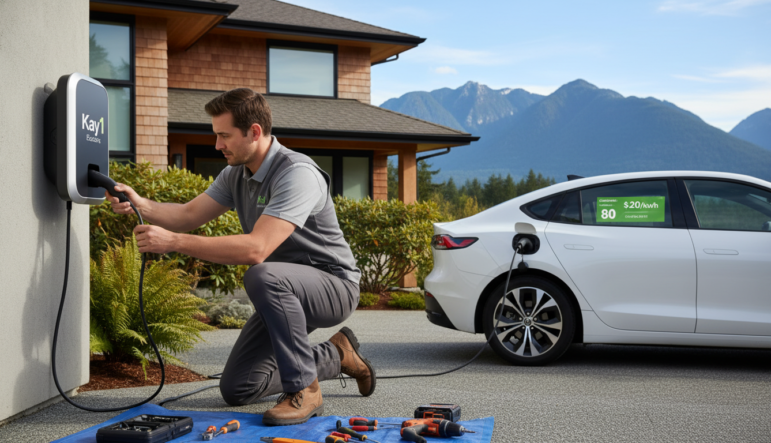
How Much Does It Cost to Install an EV Charger in Vancouver ?
Surprising fact: a typical home charging budget today most often lands between $500 and $2,500, depending on electrical readiness and routing complexity.
We write this so you can budget with fewer surprises. Homeowners often mix up the price of the charger and the labour, permits, or materials that follow.
Level 2 units usually run about $300–$1,200, and smart features can add roughly $100–$300. What drives the price more than neighbourhood is your panel condition and wiring route.
We set clear expectations, outline common price brackets, and explain when a quote needs more detail. Safety matters: continuous load work should be done by a licensed electrician to protect your home and insurance position.
For a clear, local quote across Coquitlam, Vancouver, North Vancouver, and West Vancouver, call us at (778) 900-1004. Kay1 Electric LTD will guide you through rebates and realistic out‑of‑pocket planning.
Key Takeaways
- Typical home budgets fall between $500 and $2,500 based on complexity.
- Hardware price and labour are separate—compare quotes carefully.
- Your electrical setup and routing affect final costs most.
- Licensed electricians and certified gear keep you safe and insured.
- Rebates in B.C. can lower your net spending; plan for out‑of‑pocket totals.
- Call Kay1 Electric LTD at (778) 900-1004 for a local, detailed quote.
What “installing an EV charger” means for Vancouver homeowners
A true home charger setup starts with an electrical review, not with the hardware box.
We define charger installation as a clear, step‑by‑step process: electrical assessment, circuit planning, protection and wiring, mounting or receptacle work, commissioning, and permit/inspection coordination.
Home charging goals begin with matching daily kilometres to charging speed. Level 1 (120V) provides about 1–1.5 kW. Level 2 (240V) runs roughly 3.3–19.2 kW and is often set near 6.6 kW for overnight top‑ups.
Common Vancouver scenarios
- Detached garages and laneway homes—short runs but may need weatherproofing.
- Carports and outdoor pads—longer cable routing and coastal exposure to consider.
- Condo and strata parking—access and permit rules can limit options.
| Location |
Typical challenge |
Common solution |
| Detached garage |
Short route, dry |
Wall‑mounted unit, simple circuit |
| Outdoor parking |
Longer run, exposure |
Weatherproof wiring, conduit |
| Condo stall |
Strata rules, shared panels |
Stall allocation, metering options |
We weigh convenience and safety when choosing the best location: pick where you park, ensure cable reach, and keep runs short to limit heat and hazards.
Call (778) 900-1004 for a quick assessment. We can review BC Hydro MyHydro meter data and outline the likely path for your charger home project.
Charger levels and hardware choices that shape your budget
Choosing the right level chargers starts with matching daily driving to charging speed. That keeps upgrades focused and avoids waste.
Level 1 on a 120V outlet
When minimal work makes sense: Level 1 uses 120V and gives about 1–1.5 kW. Expect roughly 100 km in ~19 hours, vehicle dependent.
This is practical for low-mileage drivers or occasional use. It avoids new wiring but can be slow for commuting households.
Level 2 home unit on 240V
Level 2 runs broadly from 3.3–19.2 kW (commonly 6.6 kW) and adds about 100 km in ~5 hours.
Why most homeowners pick this level charger: faster overnight top-ups, dedicated circuit use, and smart scheduling support for time-of-day rates.
Level 3 DC fast charging
Level 3 delivers 50–350 kW and is designed for public charging stations. It can add ~100 km in 5–35 minutes depending on power and vehicle acceptance.
It is rarely a realistic residential option due to major electrical demands and site work.
Features that change selection
- Amperage choices (≈15–80A) affect charging speed and panel needs.
- Cord length (5 m vs 7.6 m) trades storage neatness for parking flexibility.
- Networked features enable time‑of‑day optimisation and Peak Saver programmes.
Connector compatibility matters: J1772/CCS and NACS (J3400) are common in Canada; use manufacturer‑approved adapters.
Need help choosing the best option? Call (778) 900-1004 and we’ll review compatibility before you buy.
EV Charger Installation Cost in Vancouver: realistic price ranges to plan around
We separate the project into three clear line items: the unit, the installation work, and the compliance fees. That makes budgeting simple and reduces surprises when a quote arrives.
Charger price range and what each tier delivers
Hardware tiers:
| Tier |
Price (approx.) |
Typical features |
| Budget |
$300–$500 |
Basic 240V, modest amperage, short cord |
| Mid‑range |
$500–$900 |
Higher amps, weatherproofing, longer cord |
| Premium |
$900–$1,500+ |
App control, load sharing, heavy‑duty enclosure |
Typical labour and common extra charges
Straightforward installs often fall between $500 and $1,000. Labour and new circuit work usually sit in the $400–$1,500 band, with wiring runs commonly $200–$800 depending on length.
Costs rise when routes are long, walls must be opened, trenching is needed, or the panel needs upgrades. Permits and inspections add roughly $50–$500 but protect safety and resale value.
Practical takeaway: the fastest way to get an accurate price is an electrician visit or detailed remote intake. Call (778) 900-1004 for a Vancouver-area quote that includes permit and inspection planning.
Home electrical factors that most affect installation costs
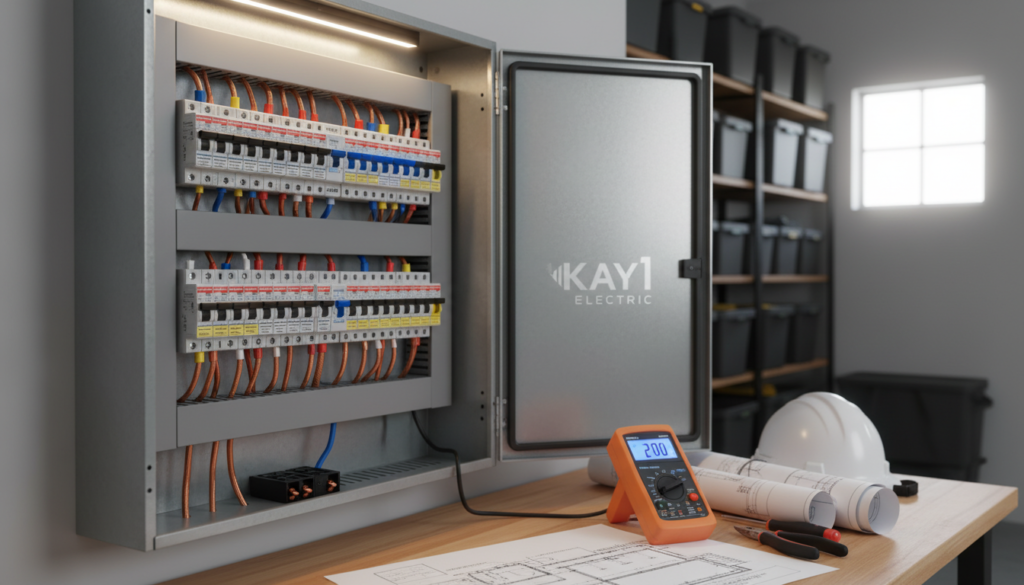
Before any work starts, the single biggest driver of final pricing is your panel and the real spare capacity in your home. We assess actual load using the past 12 months of meter data (for example, BC Hydro MyHydro) so you don’t pay for unnecessary upgrades.
Electrical panel capacity and spare load: 100A vs 200A service and beyond
Your panel rating determines what charging speeds are realistic without upgrades. A 100A service may limit high‑amp Level 2 options, while a 200A service usually offers more headroom.
New 240V circuit requirements
A new 240V circuit needs a correctly sized double‑pole breaker, wire sized for the amperage, and proper conduit routing. You can choose a receptacle (outlet) or a hardwired connection depending on the unit and site.
Panel changes and service upgrades
Replacing an old or crowded panel (panel change) differs from increasing service capacity (service upgrade). Both affect timelines and pricing; upgrades often run into the low thousands in many markets, but Vancouver quotes are site‑specific.
Load management devices as an alternative
Load management systems let your home share available power and can avoid a full service upgrade. They’re a cost‑saving option when the system is near its limit and support a range of amperage settings.
Choosing the best location
Pick a location that keeps the run to the panel short, matches parking layout, and limits weather exposure. Moving the unit a few metres can cut materials and labour and lower installation costs meaningfully.
Next step: Book an assessment so we can confirm panel condition, breaker space, and the ideal routing plan. Call Kay1 Electric LTD at (778) 900-1004 to schedule your quote.
Rebates, rates, and rewards that can lower your net cost in B.C.
Rebates and rate programs can cut your final bill more than many homeowners expect. We summarise the main incentives and explain what you must document to actually receive them.
Home and device rebates
Home rebate: up to 50% of eligible purchase and installation, to a maximum of $350 for single‑family homes, row homes, and duplexes.
Power management device rebate: up to $200. This can avoid a full service upgrade by balancing household load.
Strata and multi‑unit pathways
- EV Ready plan rebate: 75% to $3,000.
- Infrastructure support: up to 50% to $600 per stall (project max $120,000).
- Charger funding: up to 50% to $1,400 per charger (complex cap applies).
- Standalone networked station rebate: up to 50% to $2,000 per unit (pre‑approval required).
Ongoing savings
Time-of-day rates lower overnight charging bills. Peak Saver offers a $250 enrolment bonus plus $50 seasonal rewards for eligible equipment.
Pro tip: many rebates require pre‑approval, specific model numbers and installer details. Call us at (778) 900-1004 so we can confirm eligible equipment and paperwork before you buy or start installation.
How to get an accurate quote and choose the right electrician
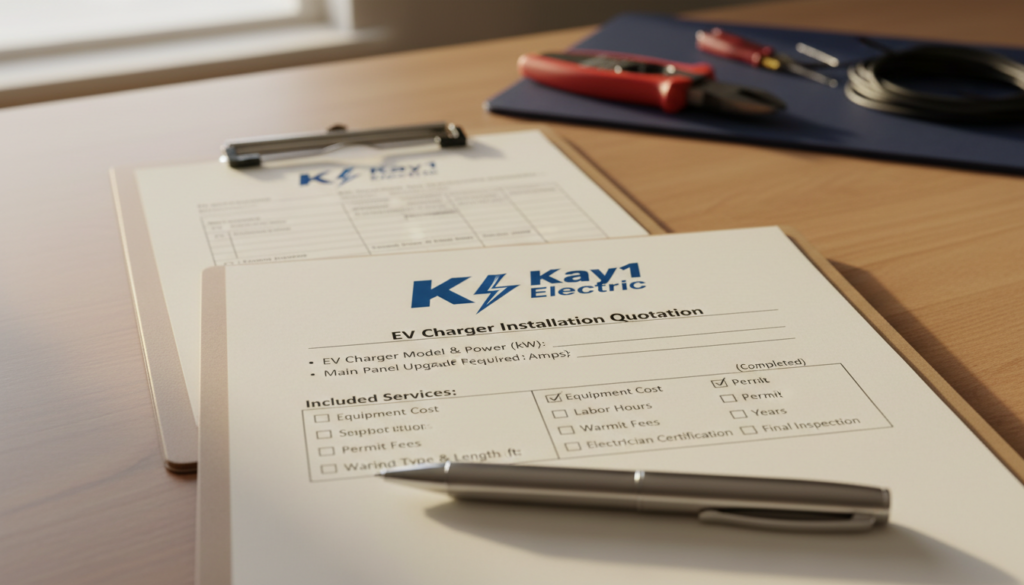
Getting a precise quote starts with clear questions and real meter data, not guesswork.
We recommend a short checklist you can use to compare bids. Ask what the quoted work includes, whether the permit and inspection are covered, and what warranty applies to labour and parts.
What to ask during quoting
- Does the price include the permit, inspection and commissioning?
- How many installs have you completed and which brands do you install?
- What warranty covers your work and the equipment?
- Will electricians provide documentation needed for rebates?
What a licensed electrician should assess
They must review 12 months of meter data to measure spare capacity. We use real usage, not estimates, to avoid unnecessary panel upgrades.
On site, expect checks of the panel, breaker space, planned circuit sizing, routing and whether an outlet or hardwired connection is best for the charger home setup.
Buying the unit and next steps
Contractor-supplied gear simplifies compatibility and ensures rebate eligibility. Retail purchases can save money but require you to verify model approval.
“Choose a safety-certified unit and a licensed contractor who documents permits and final inspection.”
| Option |
Pros |
Cons |
| Contractor-supplied |
Compatibility, warranty support |
Higher sticker price |
| Retail/online |
Lower price choices |
Must verify rebate eligibility |
| Dealership |
May include a Level 1 cable |
Limited model selection |
Next step: To request a quote to install charger home or to install charger home and complete the setup, call Kay1 Electric LTD at (778) 900-1004. We serve Coquitlam, Vancouver, North Vancouver and West Vancouver.
Conclusion
Start by pairing how far you drive with what your electrical panel can safely support at home. Pick the right level for your routine, then confirm the ideal location to keep wiring simple and safe.
Remember: total cost reflects the unit, labour, permits and any required upgrades. The cheapest unit may still raise your overall costs if panel work or major electrical upgrades are needed.
Level 1 is low priced but slow. Level 2 offers the best overnight balance for most Vancouver homes. Many households avoid major upgrades with proper circuit planning or load management.
Align your purchase and paperwork to claim rebates, and call us to move forward. Call (778) 900-1004 to discuss your home, your vehicles, and a safe, cost-effective plan with Kay1 Electric LTD.
FAQ
How much does it typically cost to install a home charging station in Vancouver?
Prices vary by equipment and electrical work. Expect a basic 240V unit plus a straightforward install to start in the low thousands, while projects requiring panel upgrades, long cable runs, trenching or permits can push the total higher. We recommend a site assessment to give you a firm quote based on your home’s panel, distance from the garage or parking spot, and any required permits.
What does “installing an electric vehicle charger” involve for Vancouver homeowners?
It means adding dedicated wiring and a protected circuit from your main service or subpanel to the chosen parking location, mounting the unit or receptacle, and completing local permits and inspection. The work can be a simple outlet installation or a full hardwired station with a new breaker and safety components, depending on your charging goals.
How do I match charging speed to my daily driving needs?
Consider how many kilometres you drive daily and when you park. For typical daily commutes, a 240V Level 2-style unit that provides overnight top-ups is usually sufficient. If you have long daily mileage or need rapid turnaround between trips, discuss higher amperage equipment or managed solutions with your electrician.
What are common installation scenarios in Vancouver homes and garages?
Typical scenarios include installing a unit in an attached garage with short wiring runs, mounting a unit on an exterior wall near a driveway, or adding a covered parking stall in a strata building. Each scenario affects labour, cable length and whether trenching or conduit is needed.
What’s the difference between low-voltage outlet charging and 240V home units?
A standard 120V outlet provides slow charging suitable for low daily mileage and usually requires little to no electrical work. A 240V home unit delivers much faster charging overnight and often requires a new dedicated circuit, a 240V breaker and professional installation.
Is fast DC charging a realistic option for homes in Vancouver?
DC fast systems require industrial power and specialised equipment; they draw far more current than residential services typically support and are rarely practical or economical for private homes. They’re best left to commercial or public sites.
Which hardware features increase the price of a unit?
Higher amperage capability, smart networking and app features, longer integrated cords, and robust weatherproof ratings raise equipment prices. If you need NEMA-rated outdoor gear or load-sharing capability for multi-vehicle setups, expect higher upfront costs.
What connector types should Vancouver homeowners consider?
Most Canadian vehicles use the J1772 standard for AC charging; for faster public charging, CCS is common. Newer North American Vehicle Charging Solution (NACS) adaptors and ports are also appearing. Choose equipment compatible with your vehicle or use an approved adaptor where needed.
What are realistic price ranges for residential 240V units?
Entry-level home units with basic features are more affordable, mid-range units add higher amperage and Wi‑Fi, and premium units include advanced load management and larger warranties. Your electrician can show models across these tiers and how each affects installation complexity.
What labour and installation tasks are included in a straightforward setup?
A straightforward job typically includes running a dedicated 240V circuit from your panel, installing a breaker, mounting the unit, basic cable protection, and completing permit paperwork and inspection. Labour time depends on distance and mounting surface.
When do costs increase significantly during installation?
Costs rise with longer wire runs, trenching between the panel and parking area, significant wall repairs, complex routing through finished spaces, or when inaccessible panels require more labour. Upgrades to the electrical service also add materially to the bill.
Do I need permits and inspections in Vancouver?
Yes. Most installations require a permit and an electrical inspection to meet local codes and ensure safety. Permits affect timelines and the final price, but they protect your home and may be required for rebate eligibility.
How does panel capacity affect whether I need a service upgrade?
If your main service is already near capacity, adding a high‑amperage circuit can overload the panel. Homes with 100A service are more likely to need an upgrade than those with 200A. An electrician will check meter data and spare capacity to determine whether an upgrade is necessary.
What’s required for a new 240V circuit: outlet vs hardwired?
A new 240V circuit requires correct breaker sizing, appropriately gauged conductors, and suitable cable routing. Some units plug into a 240V outlet, while others are hardwired. Outlet installs allow easier future replacement, but hardwired units can offer a cleaner finish and may be required by some manufacturers.
When will I need a panel change or service upgrade?
You’ll need an upgrade if there’s insufficient breaker space, the service amperage is too low for your charging needs, or the panel is outdated and can’t safely accept modern breakers. Upgrades increase cost but ensure reliable, code-compliant operation.
What are load management devices and when are they a good option?
Load management systems let multiple chargers share a single service by dynamically limiting each unit’s draw so you avoid costly service upgrades. They’re a cost‑effective alternative in homes or multi-family buildings with limited service capacity.
How do I choose the best charger location at my property?
Pick a location close to the electrical panel to reduce wiring length, consider parking angle and convenience, and protect the unit from severe weather. Accessibility and future vehicle changes should guide placement.
What rebates and incentives are available in B.C. to lower net costs?
British Columbia offers various rebates for home equipment and power management devices that can reduce installation expenses. Programs change periodically, so check current provincial and utility offers or ask your electrician to confirm eligibility and application steps.
Are there rebates specifically for load management devices?
Yes — some programs incentivise power management gear to avoid full service upgrades. These rebates help cover the cost of smart splitters or energy management hardware that balance load among appliances and chargers.
How do strata and multi-unit properties handle charging infrastructure?
Many strata complexes adopt EV Ready plans, run communal infrastructure, or support per-stall upgrades. Building managers can access specific incentives and design standards. Early planning makes installations simpler and more cost effective for residents.
How can time-of-day rates and utility programs save money with home charging?
Charging during off-peak hours reduces electricity bills. Utilities in B.C. may offer Peak Saver or time-of-day pricing that rewards overnight charging or controlled load events when your charger is eligible and connected to smart features.
What should I ask when getting quotes from electricians?
Ask about permits and inspections, warranty on labour and equipment, their experience with vehicle charging stations, whether they handle rebate paperwork, and a clear breakdown of materials versus labour. Request references and examples of similar installs in Coquitlam or Vancouver.
What will a licensed electrician assess during a site visit?
They’ll check panel capacity, meter history if available, available breaker space, distance to the parking spot, potential routing for cables, and any obstacles that affect cost. This assessment yields an accurate, written quote.
Should I buy the unit myself or have the contractor supply it?
Buying yourself can let you choose the model and qualify for manufacturer deals, but contractor-supplied units simplify warranty handling and compatibility. Confirm rebate eligibility for retail purchases and ensure the electrician will install the specific model you select.
How do I request a quote or next steps for a home charging install?
Contact Kay1 Electric LTD to schedule a site assessment and written quote. We serve Coquitlam, Vancouver, North Vancouver and West Vancouver and guide you through permits, rebates and installation. Call us at (778) 900-1004 to get started.