loading
608 Como Lake Ave, Coquitlam, Vancouver, V3J0B2
07:00 AM - 09:30 PM

608 Como Lake Ave, Coquitlam, Vancouver, V3J0B2
07:00 AM - 09:30 PM
Post Image
06 Feb, 2026
Posted by kay1electric
0 comment

Switching to LED: How Businesses Save Money on Energy Bills

Did you know a typical commercial retrofit can cut lighting energy use by up to 60%? That scale of savings transforms monthly costs and improves comfort in the spaces where people work.

We explain why an office LED change is one of the most reliable, measurable building improvements you can make. It reduces energy draw, lowers heat output and keeps disruptions to daily work minimal.

Practical benefits include lower monthly bills, fewer lamp changeouts and a calmer, more productive atmosphere. LED fixtures last longer and cut waste heat, which in turn eases HVAC loads in many Canadian buildings.

In this how-to guide we cover assessing current systems, setting illumination targets, choosing fixtures and bulbs, and adding controls for extra savings. We position Kay1 Electric LTD as your local Vancouver-area partner for planning and installing a safe, code-compliant retrofit in Coquitlam, Vancouver, North Vancouver and West Vancouver.

Ready for fast numbers or a site visit? Call Kay1 Electric LTD at (778) 900-1004 to discuss timelines and next steps.

Key Takeaways

  • LEDs cut energy use and reduce monthly bills.
  • Less heat from lamps can lower HVAC demand.
  • Minimal disruption with measurable, fast results.
  • We guide assessment, fixture selection and controls.
  • Kay1 Electric LTD serves Coquitlam, Vancouver, North & West Vancouver — call (778) 900-1004.

Why LED office lighting is one of the fastest ways to cut energy bills

A targeted LED swap is one of the quickest ways to trim building energy costs. LEDs deliver equal or better light with lower wattage, so savings show up immediately on utility bills.

Many workplaces still run fluorescent light fixtures that draw more power and need frequent maintenance. Replacing those with modern led lighting reduces energy consumption and service interruptions.

Beyond lower watts, LEDs last longer and emit less heat. That lowers cooling demands and creates secondary savings in HVAC energy. Over months, small per-fixture cuts add up when lights run many hours.

Where to start: open-plan work areas, corridors and meeting rooms usually yield the fastest payback. The best results come when we pair the right led lights with a thoughtful layout and simple controls, so the whole system works smarter, not harder.

  • Lower wattage per lamp = direct bill reduction.
  • Fewer replacements reduce maintenance costs.
  • Less heat improves comfort and reduces cooling energy.

To discuss a quick assessment in Coquitlam or Vancouver, call Kay1 Electric LTD at 7789001004.

Assess your current office lighting and energy consumption before you upgrade

We start with a one-loop walkthrough to document visible faults and comfort gaps. This quick pass highlights flicker, dark areas, glare and harsh shadows that affect work and safety.

Spot the red flags

Note any flicker — it often signals aging drivers or ballasts. Mark dark areas where spacing or worn tubes cause low light. Record glare and shadows that interfere with screens and task surfaces.

Benchmark energy consumption

Gather recent electricity bills and capture kWh, billing period and demand lines. That gives a clear baseline for before‑and‑after comparisons.

Include employee input

Ask employees about comfort, brightness and specific tasks that need better light. Their feedback identifies priority areas like open workstations and conference rooms.

  • What we need to price it: fixture counts, operating hours, problem areas, and a copy of recent bills.

Ready to move from notes to numbers? Call Kay1 Electric LTD at 7789001004 for a site visit in Coquitlam, Vancouver, North Vancouver or West Vancouver.

Set performance targets for illumination, productivity, and comfort

Start by setting measurable targets for how much light each space needs and why those numbers matter for comfort and productivity.

We define clear illumination goals so your team can work without strain. Targets let us plan to meet task needs, support mood and protect concentration.

Recommended brightness by area

Area Recommended levels (lux) Why it matters
General tasks 300–500 lux Comfortable for most desk work and visual focus
Detailed work 500–750 lux Reduces errors for precise tasks
Conference rooms 200–300 lux Balanced for presentations and meetings
Hallways 100–200 lux Safe circulation and wayfinding

Standards and glare control

We reference standards such as the GSA guidance of roughly 500 lumens per square metre as a baseline when planning coverage.

To reduce glare and harsh shadows near screens, we use careful fixture placement, diffusers and task lamps. This minimizes eye strain and headaches and improves daily productivity.

If you want a measured plan for your space, call us at 7789001004.
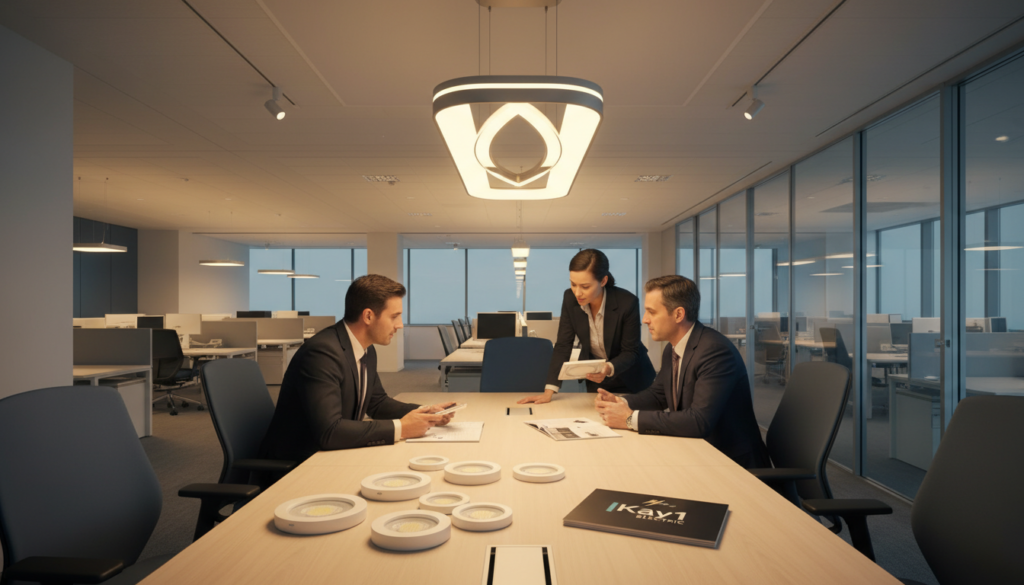
Office Lighting Upgrade options: retrofit kits, new LED fixtures, and better bulb choices

A modern office interior showcasing various LED lighting upgrade options, centered around a sleek conference room table. In the foreground, highlight a new LED fixture with a stylish design, alongside LED retrofit kits neatly arranged. In the middle ground, include professional business people discussing lighting choices, dressed in smart business attire, examining the fixtures. The background features a bright, open workspace with natural light filtering through glass windows, enhancing the mood of efficiency and innovation. Use soft, warm lighting to create an inviting atmosphere, and include the brand name "Kay1 Electric" subtly integrated into the scene, perhaps on a brochure placed on the table. Use a wide-angle lens perspective to capture the space effectively.

Replacing high-use fixtures first yields the quickest return and cuts maintenance visits. Start by listing high-burn and hard-to-access areas. These deliver the fastest payback and reduce ladder time.

We outline three practical paths so you can match cost, disruption and savings.

  • Retrofit kits: Keep existing housings and swap in led modules. This option is cost-effective and fast.
  • Full fixture replacements: Best when housings are damaged or incompatible. New fixtures improve beam control and diffuser quality.
  • Targeted bulb swaps: Quick, low-cost swaps where fittings are in good condition.

Choosing the right solutions

Compare leds to fluorescent light on efficiency, expected lifespan and simple maintenance. LEDs use less power, last longer and cut service calls.

For common areas we recommend troffer retrofits for grid ceilings, LED panels for uniform ambient light, and task lighting for desks and detailed work.

When you’re ready, call Kay1 Electric LTD at 7789001004 for a site review in Coquitlam, Vancouver, North Vancouver or West Vancouver.

Choose the right colour temperature, brightness, and lighting types for each space

Choosing the right colour temperature and fixture mix makes each space work better for people and tasks. We select colour and brightness to support specific activities — focused work, meetings, or relaxation — so the environment matches its purpose.

Colour temperature and mood

Kelvin matters: warm (2,700–3,000K) creates a relaxed feel; neutral (3,500–4,000K) suits mixed-use zones; cool (4,000–5,000K) promotes concentration.

Some LEDs are tunable to mimic natural light through the day, which helps maintain alertness and steady concentration.

Layering types for balanced light

Layer ambient lighting for general coverage, add task lighting at desks, use accent fixtures for interest, and place corrective light behind monitors to reduce contrast.

  • Use natural light where possible, then fill with LEDs to keep brightness consistent.
  • Prefer indirect or direct-indirect fixtures in screen-heavy areas to soften glare and reflections.
  • Specify optics — diffusers, lenses and louvers — to avoid hotspots and ensure even distribution.

If you want tailored recommendations for your Vancouver or Coquitlam space, call Kay1 Electric LTD at 7789001004.
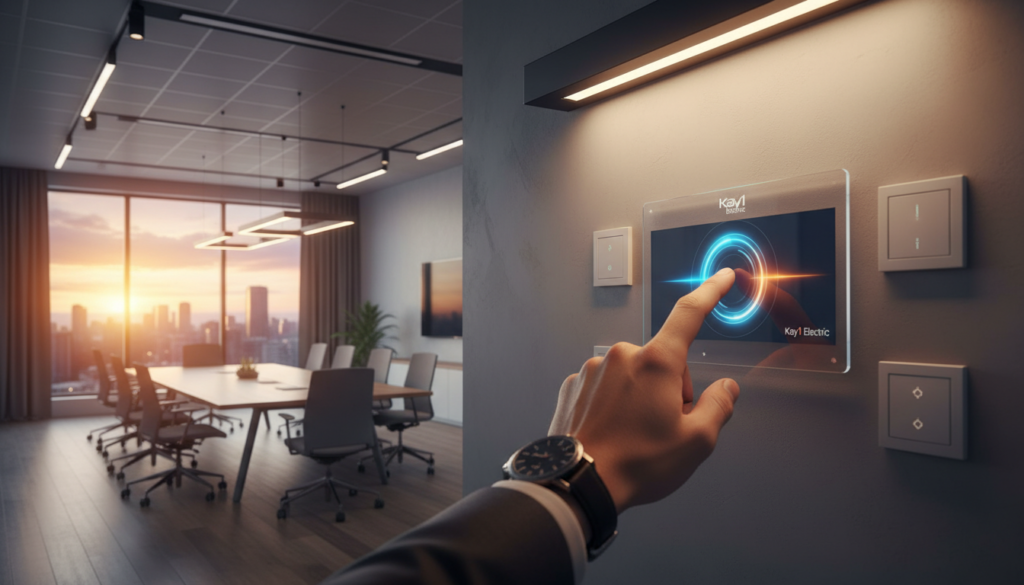
Add lighting controls to reduce energy use even further

A modern office interior showcasing advanced lighting controls, prominently featuring sleek touch-panel interfaces and programmable switches labeled with the brand "Kay1 Electric." In the foreground, a hand adjusts a control panel with a soft glow emanating from adjustable LED fixtures above. The middle ground displays a spacious meeting room with large windows letting in natural light, blending with energy-efficient LED lights creating a harmonious ambiance. The background reveals the cityscape outside, with a vibrant sunset highlighting the ecological benefits of smart lighting. The image captures a professional atmosphere, suggesting innovation in energy savings, with a warm, inviting color palette and a focus on clarity and functionality.

Smart controls turn efficient fixtures into a truly low‑consumption system by cutting wasted run time. Once LEDs are fitted, controls are the second lever that trims hours when lights run with no benefit.

Motion sensors for meeting rooms, washrooms and low‑traffic areas

Motion sensors deliver fast, visible savings in rooms that are used intermittently. Meeting rooms, storage closets, washrooms and break areas often have lights left on “just in case”.

We place sensors to avoid false trips and set sensible timeouts so people are not interrupted while they work.

Dimmers, scheduling, and daylight tracking

Dimmers and schedules match output to occupancy and the progress of the day. Daylighting controls reduce output near windows as natural light increases.

This lowers energy consumption and keeps visual comfort steady across sunny and cloudy periods.

What “up to 55% more energy savings” can mean

“With effective controls, you can see up to 55% more energy savings compared with fixtures alone.” — Philips

In practice, that means comparing actual hours lights are needed to current run hours and applying realistic reductions. If fixtures currently run 10 hours and controls cut that to 5–6 required hours, the savings add up quickly.

Wireless and smart control options

Wireless systems reduce rewiring and let you manage zones from a single dashboard. This option simplifies installation in occupied spaces and speeds commissioning.

  • Practical tips: zone your spaces, avoid nuisance shutoffs, and tune sensitivity for comfort.
  • Management: use schedules and analytics to track savings and refine settings.

Want a controls plan for your Vancouver or Coquitlam space? Call Kay1 Electric LTD at 7789001004 to discuss smart solutions and confirm expected savings.

Estimate total cost, incentives, and long-term savings for Canadian businesses

Before you sign a quote, compare upfront spend to long-term declines in energy bills. We show how to think like a facilities manager: weigh project costs against lifetime value from lower energy consumption and fewer replacements.

Upfront costs vs lifetime value

LEDs cost more initially but cut electricity and maintenance bills over time.

Less heat also lowers cooling demand in dense offices, reducing HVAC energy during busy hours.

Build a simple payback model

Use fixture counts, wattage before/after, hours of use and your electricity rate to forecast savings.

Start a spreadsheet: list fixtures, existing watts, new watts, hours/day and rate. Multiply to get annual kWh and dollars.

Rebates and financial incentives

Look to utilities, provincial programs and federal efficiency grants. Documentation usually needs project scope, invoices and measured savings.

Item Typical input Why it matters
Fixture count Number of units Drives total wattage change and material cost
Hours of use Operating hours/day Key to annual energy consumption
Electricity rate ¢/kWh Converts kWh savings to dollar savings
Rebate value $ or % Reduces upfront costs and shortens payback

We can validate your assumptions on-site and turn estimates into reliable numbers. Call Kay1 Electric LTD at 7789001004 for a local review in Coquitlam, Vancouver, North Vancouver or West Vancouver.

Conclusion

Treating your workspace as a system ensures predictable energy and comfort gains. We assess current office lighting, set clear targets, choose the right led lights and fixtures, then add controls to lock in ongoing savings.

That approach cuts energy costs, reduces maintenance, and improves day-to-day productivity. Good design also reduces glare and evens the light so your team can focus without strain.

We advise treating bulbs, layout and controls together—not as isolated swaps—so results are measurable and repeatable.

For a practical plan in Coquitlam, Vancouver, North Vancouver or West Vancouver, call Kay1 Electric LTD at (778) 900-1004 and we’ll walk your site and outline next steps.

FAQ

What are the first steps to evaluate existing office lighting and energy use?

Start by walking the space during work hours and noting flicker, dark areas, glare and heavy shadowing. Collect recent electricity bills to benchmark total consumption, and count fixtures and bulb types. Combine this with employee feedback on comfort and task needs to prioritise areas for improvement. We can perform a formal audit in Coquitlam, Vancouver, North Vancouver and West Vancouver to speed this up—call 778-900-1004.

How quickly do LEDs reduce energy bills compared with fluorescent fixtures?

LEDs typically use 40–60% less power than fluorescent tubes for similar light output and require far less maintenance. Savings appear immediately on monthly bills and grow over time because of longer lifespans and reduced replacement costs. Exact savings depend on hours of use, fixture counts and controls such as dimmers or motion sensors.

When should we choose retrofit kits versus full fixture replacements?

Retrofit kits make sense when existing housings are in good condition and rewiring is costly; they’re lower upfront cost and faster to install. Full fixture replacements are better when you need improved light distribution, integrated controls, or modern aesthetics. We assess the condition and energy payback to recommend the best option.

What colour temperature and brightness should we use for different areas?

Use cool or neutral white (4000–5000K) for general work zones and detailed tasks to support alertness and contrast. Warmer tones (2700–3500K) suit break rooms and reception areas for a relaxed mood. Recommended illuminance: general tasks ~300–500 lux, detailed work 500–750 lux, conference rooms 300–500 lux, hallways 100–200 lux. Layer lighting with task fixtures to avoid over-illumination.

How do lighting controls improve energy savings in commercial spaces?

Controls such as motion sensors, occupancy timers, daylight harvesting and dimmers reduce wasted runtime and adapt output to natural light. In practice, combining controls with LEDs can yield up to 50–55% additional energy savings depending on usage patterns. Wireless smart systems reduce rewiring and simplify management across multiple rooms.

Can switching to LEDs lower building cooling costs?

Yes. LEDs emit significantly less heat than traditional sources, reducing the cooling load on HVAC systems. That effect adds to lifetime savings, especially in sunlit or densely occupied spaces. We factor reduced cooling in payback models for a complete picture of lifetime value.

How do we build a simple payback model for a retrofit project?

Multiply fixture count by installed wattage difference (old vs new) and by annual operating hours to get kWh saved. Multiply kWh saved by your electricity rate to estimate annual dollar savings. Compare those savings to upfront costs (equipment + installation) to calculate simple payback in years. We can run numbers for your specific bills and use local rebate data.

Where can Canadian businesses find rebates or incentives for energy-efficient lighting?

Incentives vary by province and utility provider. BC Hydro, FortisBC and municipal programs often offer rebates for LEDs and controls. Federal and provincial energy efficiency programs may also contribute. We keep current on local rebates in Vancouver, Coquitlam and the North Shore and can help you apply—call 778-900-1004.

Which LED fixture types work best for common areas like open-plan workspaces and meeting rooms?

For open-plan areas, flat panels and troffers deliver even ambient light and minimise flicker. Recessed panels or indirect-direct fixtures reduce screen glare. For meeting rooms, adjustable downlights or dimmable panels with good colour rendering help set meeting tone. Task lamps add focused light for desktop work.

How do we reduce glare and eye strain around screens?

Use indirect or direct-indirect fixtures, lower mounting heights where possible, add adjustable task lighting, and choose colour temperatures that match daylight. Position fixtures to avoid direct light on monitors and use anti-glare screens if needed. Proper layout and layered lighting significantly reduce eye fatigue.

What maintenance savings can we expect after switching to LEDs?

LEDs last much longer than fluorescents—often 50,000+ hours—so you replace lamps less frequently and lower labour costs for maintenance. Fewer ballast replacements and reduced fixture failures further cut service interruptions and ongoing expenses.

Are wireless smart lighting controls reliable for retrofits in older buildings?

Yes. Wireless controls like Zigbee or Bluetooth mesh are reliable and avoid extensive rewiring, making them ideal for retrofit projects. They allow scheduling, scene setting and energy monitoring. We evaluate signal paths and recommend robust solutions tailored to older construction.
Leave a Comment

Your email address will not be published.*

Recent Comments

No comments to show.

Categories

Archive

February 2026
M T W T F S S
 1
2345678
9101112131415
16171819202122
232425262728