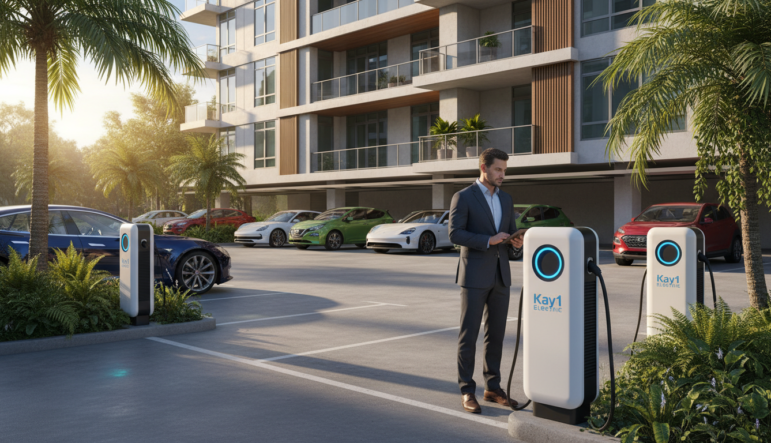
Installing EV Chargers in Condos & Stratas: What Are the Rules in BC ?
Surprising fact: as of 2021, British Columbia led North America with about 13% of new vehicle purchases being electric.
We write this guide because that trend is changing how multi-unit sites plan power and parking. Municipal bylaws now often require future-ready wiring, and rules differ by municipality.
Our aim is simple: help you avoid common approval and compliance issues when adding charging infrastructure in a shared home setting.
We explain how building constraints—shared electrical rooms, tight conduit paths and fire-safety needs—shape decisions. We also show the typical decision path: learn the rules, confirm capacity, pick equipment, secure funding, then permit and install.
If you want help navigating strata approvals, capacity checks, rebates and compliant installation in Coquitlam, Vancouver, North Vancouver or West Vancouver, call Kay1 Electric LTD at (778) 900-1004 for expert service.
Key Takeaways
- BC’s high adoption rate makes charging infrastructure urgent for residential buildings.
- Rules vary by municipality and by building; one size does not fit all.
- Start with a capacity check and a clear plan before requesting strata approval.
- Professional electrical guidance matters for load, safety and rebate documentation.
- We can guide you through planning, permits and installation—call (778) 900-1004.
Why EV charging is becoming a must-have in BC multi-unit residential buildings
As more drivers switch to electric cars, shared housing must adapt its parking and power plans.
Adoption and what it means for parking demand
In British Columbia, about 13% of new vehicle purchases were electric in 2021. That growth shows up in your parkade: more residents will want a reliable charging option in their assigned stall.
How municipal bylaws affect capacity and retrofit timelines
Municipal requirements are changing quickly. Many towns now require buildings to add or upgrade electrical capacity when doing renovations. Those rules vary by community and can drive scope, budget, and timing.
“Treat charging as core building infrastructure—like internet or access control—to avoid costly rework later.”
Start with a clear plan. A simple strategy prevents undersized panels and piecemeal installs that don’t scale.
| Issue |
Impact |
Action |
| Rising demand |
More stalls need power |
Survey resident interest |
| Local bylaws |
Mandatory upgrades possible |
Confirm municipal rules |
| Electrical capacity |
Limits retrofit options |
Perform load study |
If you’re unsure whether your building is on a bylaw clock or need project guidance, call us at (778) 900-1004. We work with owners, strata councils and townhome managers to map next steps.
Condo EV Charging BC: strata rules, approvals, and resident responsibilities

Before a single wire is run, you must map approvals, money and shared-use rules for your building. We guide strata councils and owners through the steps that limit delays and disputes.
Reviewing bylaws and approval pathways
Start by reading strata bylaws and any municipal requirements. Note what is common property and what needs council approval.
Typical paths include owner applications for individual stalls, council approval for conduit routing, and council-led projects for shared infrastructure.
Who pays and what the purchase means
Define equipment, installation and ongoing costs up front. Decide whether the owner or strata owns the unit and who pays for power.
Resident user agreements
Create a short user agreement covering access, billing, maintenance and insurance. Link the agreement to rebate documentation and record keeping.
| Topic |
Common Outcome |
Who Acts |
| Stall install |
Owner pays; council permits |
Owner + contractor |
| Shared hub |
Strata funds; shared billing |
Council + property manager |
| Maintenance |
Defined service plan |
Strata or owner |
Involve your contractor early—technical limits shape approvals. Call Kay1 Electric LTD at (778) 900-1004 to coordinate applications, scope and documentation before you spend money.
Plan the project with an EV Ready Plan and the right stakeholders
Begin by defining a building-wide ready plan that maps electrical upgrades and timelines.
An EV Ready Plan is a simple roadmap showing how to upgrade service, panels and conduit so each unit can have at least one ready parking space. This prevents piecemeal work that blocks future installs and raises costs.
Who can prepare the plan
In British Columbia the plan must be prepared by a licensed electrical contractor or a professional engineer.
This credential matters: it ensures safety, code compliance, and eligibility for the rebate that covers 75% of the plan cost up to $3,000.
Coordinating stakeholders and the process
Successful planning aligns owners, strata council, property management and the electrical contractor early.
We recommend this process:
- Confirm governance and scope with council.
- Commission the ready plan from a licensed contractor or engineer.
- Follow the plan with a capacity check, then choose equipment and timeline.
| Phase |
Lead |
Key Outcome |
| Governance & scope |
Strata council / property manager |
Approved project boundaries and funding approach |
| Ready plan development |
Licensed electrical contractor or engineer |
Technical blueprint for upgrades; rebate eligibility |
| Execution planning |
Contractor + owners |
Schedule, permits, and procurement |
We can coordinate the whole planning and approval pathway to keep the project moving. Call Kay1 Electric LTD at (778) 900-1004 to start your ready plan and secure rebate support.
Check electrical capacity and choose the best charging approach for your building
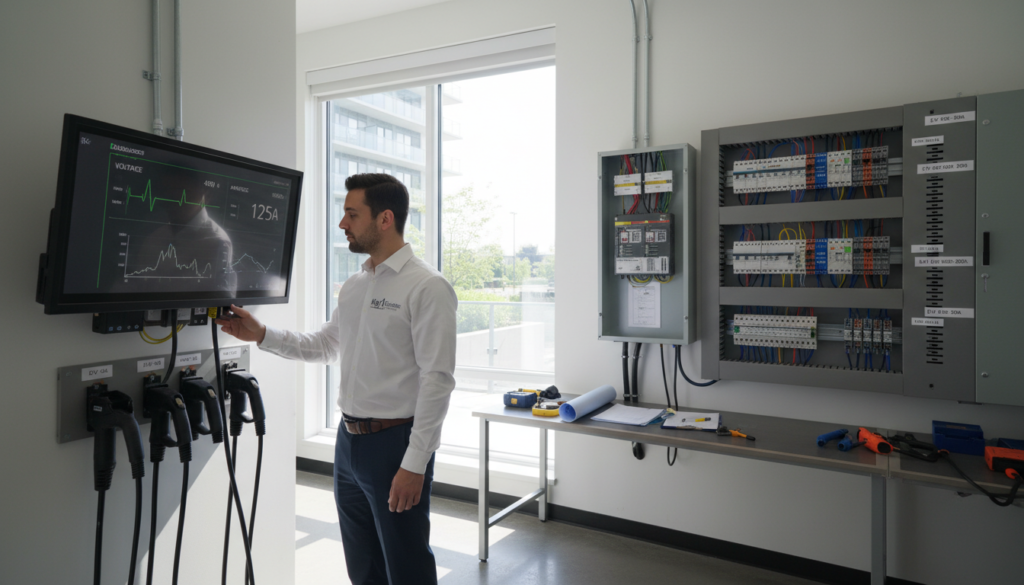
Determining available electrical capacity is the practical starting point for any shared parking project. A certified electrician must perform a load calculation as part of permitting and to define realistic options for installations.
Load calculations and why a certified electrician is required
An electrician reviews service size, main breaker rating and panel schedules. They quantify current demand and model additional loads so you don’t exceed safe limits.
Using 12-month meter usage data to confirm capacity
Utilities can supply a 12-month usage report. We use that real data to verify peak and average loads. This reduces guesswork and prevents oversizing or unsafe assumptions.
Single stall installs vs shared systems
Small buildings with spare panel capacity can often support dedicated circuits to a single stall. Larger or constrained sites usually need a managed, shared system that allocates power across multiple stalls when demand spikes.
Planning panels, conduit, wiring, telecom and future-ready infrastructure
Plan panels, conduit routes, wiring and telecom pathways together so you don’t reopen walls later. An outlet-only idea may seem cheap but often fails for billing, safety and performance.
- Step 1: Book an on-site assessment with a licensed electrician to verify electrical capacity.
- Step 2: Provide 12-month meter data for an accurate load study.
- Step 3: Select single-stall or managed shared system based on system layout and growth goals.
- Step 4: Sequence panel, conduit and telecom work to avoid duplicate costs.
We can assess your building’s constraints and recommend the best path. Call (778) 900-1004 to book an on-site assessment in Metro Vancouver.
Select rebate-eligible Level 2 chargers and design the parking stall setup
A smart selection of chargers and a practical stall design makes rebate approval and daily use much simpler.
Start by placing units where existing electrical runs can reach with minimal trenching or long conduit. This lowers labour and reduces the odds of expensive panel work.
Check technical must-haves for rebate eligibility:
- Voltage: 208V/240V permanent supply.
- Certification: cUL, ULC, cETL, CSA, or cQPS required for Canada.
- Permanent install: hardwired or dedicated receptacle, not temporary.
- Connector: SAE J1772 or NACS J3400 for broad vehicle compatibility.
- Network: internet-connected with active network service for at least two years when claimed.
Rebates and funding basics
For multi-unit residential buildings, the charger rebate is up to $2,000 per Level 2 unit, with a site cap of $14,000.
Dual-port EV equipment may qualify for higher support—verify specific program limits (up to $4,000 via some utilities or up to $10,000 under certain offers).
Timing, purchasing and eligibility notes
Obtain funding pre-approval before purchasing or installing equipment. If you buy early, you risk losing rebate eligibility.
Important update: as of March 12, 2025, Tesla-branded units are not eligible unless the project had pre-approval before that date. Choose equipment with current program eligibility in mind.
| Requirement |
Why it matters |
Practical tip |
| 208V/240V permanent feed |
Meets technical standard for fast home-level charging |
Locate stalls near panel or subpanel to reduce conduit runs |
| Canadian certification |
Ensures safety and rebate eligibility |
Verify label before purchase and include in rebate docs |
| Networked unit |
Allows billing, access control and reporting |
Budget for two years of network fees when claiming rebate |
| Pre-approval before purchase |
Protects eligibility for funding |
Submit application, then order equipment |
Think about cord length, signage, bollards and accessible stalls to reduce conflicts and improve usability for all drivers.
Need help? Call Kay1 Electric LTD at (778) 900-1004 and we’ll recommend rebate-eligible chargers and design a compliant, scalable stall layout for your site.
Installation process in BC: pre-approval, permits, inspections, and contractor documentation
Start the installation process with a clear checklist so you know what to expect at every step. Follow a simple sequence: choose a qualified electrician, confirm scope, secure funding pre-approval, then schedule permits, inspections and the physical work.
Hiring a qualified electrician
Hire a licensed electrician experienced in multi-unit projects. We recommend an electrician with EVIT training because that expertise reduces risk and keeps shared systems reliable.
Why it matters: trained contractors understand load studies, conduit routing, and meter requirements for strata applications.
Get funding pre-approval before buying equipment
Never buy a charger or order units until your program pre-approval arrives. Pre-approval protects your eligibility for the charger rebate and avoids denied claims.
Permits and inspections
Your electrician will file permit applications with the municipality or with Technical Safety BC, depending on the scope. Work must be inspected and signed off before final commissioning.
Contractor documentation and handover
At completion, collect these documents from your contractor:
| Document |
Purpose |
Who provides |
| Permit number & final inspection |
Proof work passed code |
Licensed electrician / authority |
| Itemized invoice |
Rebate application and accounting |
Contractor |
| Contractor installation form |
Required for charger rebate claim |
Contractor (retain copy) |
| Commissioning notes & photos |
Audit trail and future maintenance |
Contractor |
Practical tips: schedule any planned outages for off-peak hours and notify residents in advance to reduce disruptions. Keep one digital project folder with all permit, invoice and commissioning files for strata records and future ownership needs.
Ready to book a qualified installer? Call Kay1 Electric LTD at (778) 900-1004 and we’ll manage the application, pre-approval, permit filings and the installation work end-to-end.
Conclusion
A clear end-to-end plan prevents costly rework and keeps residents happy as infrastructure needs grow.
Successful projects treat charging as core building infrastructure, not a one-off. That view protects parking operations, electrical design and resident fairness.
Keep these requirements in view: strata approvals, compliant electrical design, permits, inspections and the records needed for rebates. Start with a ready plan so you can scale without reopening walls.
Rebates can cut costs when you follow program rules: pre-approval, eligible Level 2 charger selection, and contractor installation forms.
Infrastructure choices — conduit, panels and telecom — are costly to redo. Make them part of the initial plan and you save time and money later.
If you want a compliant, rebate-aligned installation plan tailored to your building, we can help. Call Kay1 Electric LTD at (778) 900-1004. We serve Coquitlam, Vancouver, North Vancouver and West Vancouver.
FAQ
What rules govern installing chargers in strata buildings in British Columbia?
Strata corporations must follow the Strata Property Act and any municipal bylaws. Owners planning work must review strata bylaws and get council or owner approval where required. Many municipalities have specific electrical permit and parking rules that affect capacity and installation method. We recommend starting with your strata council and a licensed electrical contractor to confirm the required approvals.
Why is vehicle charging becoming essential in multi-unit residential buildings across BC?
Adoption of electric vehicles is growing rapidly, increasing demand for convenient parking power. That trend means strata properties need to plan for charging infrastructure to preserve property values, meet resident needs and comply with evolving municipal or provincial expectations for new and retrofitted buildings.
How do municipal bylaws affect the number or type of chargers we should install?
Municipal bylaws can mandate minimum readiness, require accessible stalls, or set technical standards for metering and electrical upgrades. Some municipalities also offer incentive programs with specific eligibility rules. A local electrician or planner can review the bylaws and help you design a compliant solution.
What should we check in our strata bylaws before any installation?
Check clauses on common property alterations, use of parking stalls, voting thresholds for owner approval, and rules on who pays for upgrades. Also confirm any existing charging or electrical policies. If bylaws are silent, council may still require an owner vote for changes affecting common property or building services.
Who typically pays for equipment, installation and ongoing electricity costs?
Payment depends on the strata’s decisions. Options include individual owners paying for their charger and electricity, the strata funding shared infrastructure, or a hybrid approach. Billing for energy can be handled by individual meter submetering, separate billing systems, or direct owner payment. Document responsibilities in a resident user agreement.
What is a resident user agreement and why do we need one?
A resident user agreement sets terms for stall use, billing, maintenance, liability and access. It protects both the strata and residents by clarifying who pays for repairs, how energy is billed, and rules for shared chargers or common infrastructure. We advise having a legal review before adoption.
What is an EV Ready Plan and how does it future-proof a building?
An EV Ready Plan outlines electrical capacity, conduit routing, panel space, and recommended Charger locations to minimize future disruption and cost. It enables phased installs, reduces trenching and rework, and helps secure rebates by showing a professional plan prepared by a licensed contractor or engineer.
Who can produce an EV Ready Plan in BC?
Licensed electrical contractors and professional engineers can prepare these plans. Look for contractors with EV infrastructure experience and relevant qualifications. Kay1 Electric LTD operates across Coquitlam, Vancouver and the North Shore and can prepare plans and perform installs.
How should strata coordinate stakeholders for a charging project?
Form a working group with council members, property management, affected owners and a qualified electrical contractor. Communicate timelines, costs, approvals and any required votes. Early coordination prevents scope changes and keeps the project on budget.
Why are load calculations necessary and who must do them?
Load calculations determine if your building’s electrical service can support added chargers without unsafe overloads. A certified electrician must perform these calculations to identify panel upgrades, transformer needs, and suitable charging strategies.
Can meter usage data help confirm available electrical capacity?
Yes. Twelve months of meter data helps electricians model peak demand and spare capacity. This empirical approach leads to more accurate capacity assessments and smarter upgrade decisions.
Should we install single-stall chargers or a shared networked system?
Choice depends on parking layout, occupancy, electrical capacity and budget. Single-stall dedicated chargers suit owners who want exclusive access. Shared networked systems can serve multiple users with load management and billing features. An electrician can compare lifecycle costs and user needs to recommend the best approach.
What infrastructure elements should we plan for (panels, conduit, wiring, telecom)?
Plan for adequate panel space, labelled breakers, conduit paths to stalls, appropriate wiring gauge, ground fault protection, and power-over-ethernet or cellular internet for networked chargers. Future-proofing conduit and pull-string installation saves time and money on later expansions.
What are the technical requirements for Level 2 charging in BC?
Level 2 units generally require 208V/240V dedicated circuits, permanent mounting, and certification to Canadian standards. Choose chargers with appropriate amperage ratings and safety features; a licensed electrician must size and install the circuit.
Which connector types and networking features should we consider?
Most non-Tesla vehicles use J1772 connectors; newer trends and many Tesla owners now use NACS adapters or chargers supporting NACS. Networked chargers offer billing, access control and load balancing; ensure reliable internet connectivity (Wi‑Fi, ethernet or cellular) for those functions.
Are there recent rebate eligibility changes we should know about?
Incentive programs and eligibility rules change frequently. Note that some rebates have restrictions for certain vehicle makes or models. Always verify current program rules before purchasing equipment or starting work and obtain funding pre-approval when required.
How do we find a qualified electrician for installation in Metro Vancouver?
Hire a licensed electrical contractor experienced in charging infrastructure and EV training such as EVIT. Check references, review previous strata projects, and confirm they provide permit support, contractor installation forms and warranty documentation. Kay1 Electric LTD serves Coquitlam, Vancouver, North Vancouver and West Vancouver and can assist from planning through installation.
What municipal permits and inspections are required for charging installations?
Permits depend on the municipality and the scope of work. Typical requirements include electrical permits, inspections by the city or Technical Safety BC, and documentation of the completed installation. Your electrician should submit permits and arrange inspections as part of the contract.
Do we need to get funding pre-approval before buying chargers?
Yes. Many rebate or grant programs require pre-approval before equipment purchase or energizing. Getting pre-approval protects reimbursement eligibility and ensures the chosen equipment meets program criteria.
What documentation should the contractor provide after installation?
Obtain an installation certificate or contractor installation form, permit sign-off, wiring diagrams, photos of work, and maintenance recommendations. Keep records for warranty claims and future upgrades.
How much does a typical Level 2 stall installation cost for a strata?
Costs vary widely by distance to panels, upgrades required, and number of stalls. Basic single-stall installs may be modest, while projects needing panel upgrades, trenching or meter work increase costs. Request a site assessment and written estimate from a licensed contractor to get accurate figures.
How do we manage billing and energy recovery for shared chargers?
Options include submetering, networked chargers with per-kWh billing, or an agreement where owners reimburse the strata. Choose a solution that aligns with your strata’s administrative capacity and legal advice. Networked chargers simplify individual billing and usage tracking.
What should strata do to future-proof parking for more drivers over time?
Install spare conduit, allow reserve panel space, perform an EV Ready Plan, and adopt clear policies for stall allocation and cost recovery. Phased infrastructure installs reduce disruption and lower long-term costs.
Who is liable if a charger or wiring causes damage?
Liability depends on ownership, installation quality and who authorised the work. Proper permits, licensed electricians and adequate insurance reduce risk. Clarify liability and maintenance responsibilities in contracts and resident agreements.
How can we start the process for our building?
Begin by reviewing strata bylaws, collecting meter data, and contacting a licensed electrical contractor for an EV Ready Plan and site assessment. For professional help and local service in Coquitlam and Vancouver areas call Kay1 Electric LTD at 778‑900‑1004.