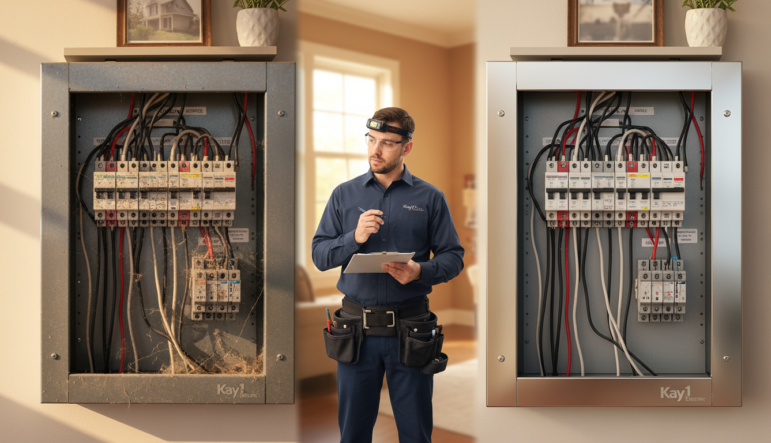
Should You Upgrade to 200 Amp Service? A Guide for Homeowners ?
Surprising fact: a typical 100-amp electrical panel delivers roughly 24,000 watts, while a 200-amp panel can supply about 48,000 watts — double the capacity.
If your breakers trip often or lights dim when the oven and dryer run, your home may be reaching its limit.
We’ll help you frame the real decision: does your current panel support how you live today, not just how the house was wired years ago?
We explain what each panel number means in practical terms, why simultaneous loads matter, and which triggers usually push homeowners toward an upgrade — EV charging, HVAC, electric cooking, or finishing a suite.
Who this guide is for: Vancouver, Coquitlam, North Vancouver and West Vancouver homeowners planning renovations, EV readiness, or fewer interruptions.
Next step: want an expert assessment for your electrical setup? Call Kay1 Electric LTD at (778) 900-1004 for a clear, local evaluation.
Key Takeaways
- Panel capacity affects how many appliances run at once, not your monthly bill.
- Dimming lights and frequent trips are common signs of inadequate capacity.
- Many modern builds use 200-amp electrical panels by default for higher demand.
- Upgrades are often triggered by EV chargers, HVAC, or major electric appliances.
- We provide local assessments across Vancouver-area neighbourhoods; call (778) 900-1004.
Why amperage matters in Canadian homes today
Think of amps as the water pipe for electricity: they control how much current can flow through your home at once. Amperage is a safety limit for wiring, not a measure of monthly use.
What amps measure in your home electrical system
An amp measures electrical current — the flow of power through your wiring. If you draw more current than the amp rating allows, breakers trip to protect the system.
How modern appliances and electrification increase demand
Today’s homes use more electric appliances and devices than older houses did. Heat pumps, electric ranges, and EV chargers add sustained loads that change planning needs.
- Practical point: one major new load can push your setup past its safe limit.
- System view: your panel, breakers, and service entrance must match expected demand.
If you’re adding big equipment or renovating, call Kay1 Electric LTD at 7789001004 for a local assessment across Vancouver-area homes.
100 Amp vs 200 Amp Service: capacity, circuits, and real-world performance
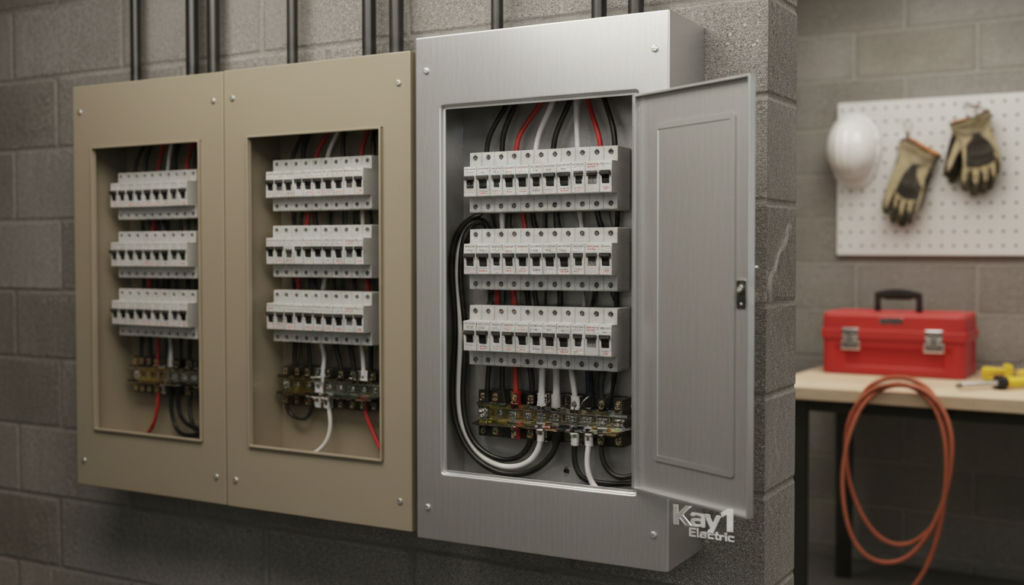
When several high-draw devices run together, the difference in panel headroom becomes obvious. We compare headline numbers so you can see what matters for daily life in Vancouver-area homes.
Maximum power capacity: a 100-amp panel gives roughly 24,000 watts of headroom; a 200-amp panel offers about 48,000 watts. That extra power matters when the oven, dryer and heat pump start at once.
| Feature |
Typical 100-amp panel |
Typical 200-amp panel |
| Wattage headroom |
~24 kW |
~48 kW |
| Circuits |
~20–30 circuits |
~40–60 circuits |
| Real-world feel |
May need to stagger appliances |
More stable under peak loads |
Signs of strain: frequent breaker trips and dimming lights are clear warnings. If you often juggle appliances to avoid trips, capacity is likely the limit.
Older homes with modest electric loads can run on a smaller panel. Modern homes or renovated properties with multiple big appliances usually need more circuits and headroom.
If you want a local assessment, call Kay1 Electric LTD at 7789001004 for advice on panel and overall service sizing.
How to tell what your home needs based on loads and appliances
Peak use, not average use, reveals whether your wiring and panel keep up with daily demands. We look at moments when multiple appliances start together. Those peaks are what stress the electrical system and trip breakers.
High-demand equipment
HVAC and central air can draw 20–50 amps. An electric range or oven often uses 40–50 amps. Dryers and water heaters each may take 20–40 amps.
EV charger readiness
A Level 2 charger commonly pulls 30–50+ amps. Adding a charger while other big loads run usually points toward a 200-amp panel for safe headroom.
Sample scenarios and planning
In a typical setup, a smaller panel quickly reaches limit when range, dryer and AC run together. A larger panel lets more devices operate at once and leaves room for new circuits during renovations or a workshop.
“Plan capacity for the future — it avoids repeated disruption and costly upgrades later.”
If your planned appliances and upgrades stack close to your service limit, call Kay1 Electric LTD at 7789001004 for a local assessment.
Cost, timing, and what affects a 200-amp panel upgrade in Canada
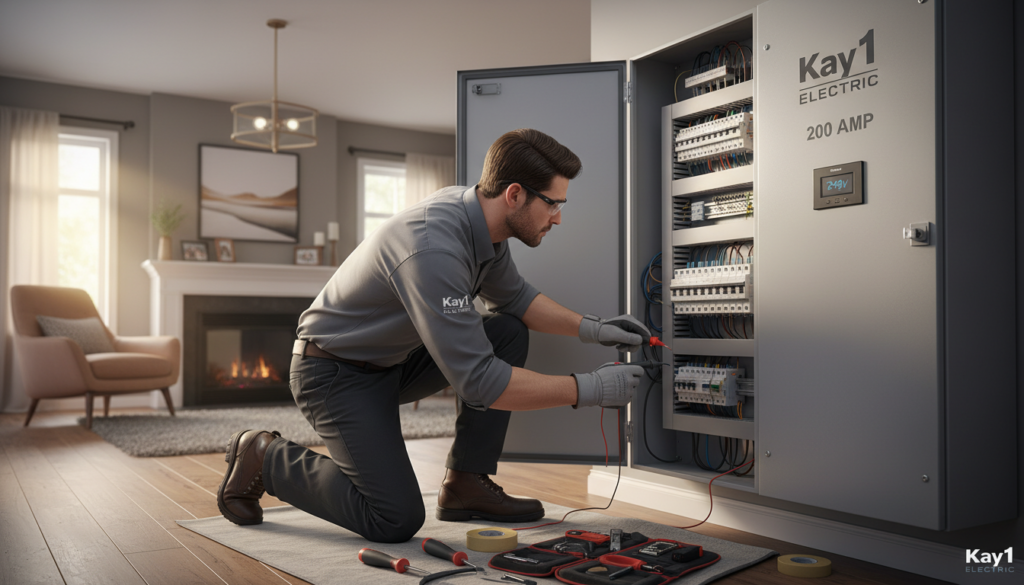
A panel upgrade affects your budget and the hours you’ll be without power.
How much you pay depends on hardware, labour, permits and utility coordination. Typical installation ranges in Canada show installing a basic 100-amp panel at about $1,800–$2,000 and a 200-amp panel near $2,200–$2,500. If you delay the work, additional wiring or meter changes can add roughly $2,000–$5,000.
What drives the final cost
Major items: the panel itself, electrician labour, permits and inspections, and utility disconnect/reconnect fees. Hidden work—service entrance cables, meter socket updates, or extra wiring—raises the total.
| Item |
Typical Canadian range |
Notes |
| Panel hardware + labour |
$2,200–$2,500 |
Standard 200-amp electrical panel installation |
| Additional wiring or meter work |
$2,000–$5,000 |
Depends on route, conduit, and socket upgrades |
| Permits & inspections |
$150–$600 |
Municipal fees and inspector time |
| Outage window |
4–8 hours |
Plan for same-day completion in most cases |
Timing and homeowner prep
We schedule installations to limit disruption. Expect a 4–8 hour power outage on the swap day. The full job is normally done in one day but varies by site conditions.
Before work, protect electronics, plan cold storage, and give our team clear access to the panel and meter. We handle permit paperwork and coordinate with the utility to disconnect and reconnect safely.
If you’re weighing cost versus disruption, we can scope the job for your home and give a clear quote. Call Kay1 Electric LTD for Coquitlam, Vancouver, North Vancouver and West Vancouver at (778) 900-1004.
Safety, code expectations, and why this isn’t a DIY job
Undersized electrical supply raises heat and stress in wiring long before visible problems appear.
Codes set a baseline: many jurisdictions treat 100 as a minimum residential reference, while a 200-amp electrical option is often recommended for larger homes or high-demand equipment. Correct sizing reduces overloads and improves efficiency.
Overloads, heat, and reducing fire risk
Repeated overloads force breakers to trip and generate excess heat in conductors. That heat speeds insulation wear and raises the chance of fires.
- Core issue: you can’t fix an undersized system by fitting larger breakers.
- Benefit: a proper panel lowers nuisance trips and voltage-drop symptoms like dimming lights.
- Older homes: older panels may lack AFCI/GFCI protections found in modern installations.
Minimum expectations and when larger panels are advised
For planned electric heating, EV charging, or major renovations, a larger panel gives the capacity and flexibility you need today and for future upgrades.
| Scenario |
Common baseline |
Recommended |
| Small, unchanged house |
Minimum residential baseline |
Maintain with inspection |
| Renovation / EV / HVAC addition |
Limited headroom |
200-amp panel recommended |
| Older panels lacking modern protection |
May be safe but limited |
Upgrade for safety & efficiency |
Installation essentials and why to hire a pro
Work on the electrical panel, grounding and meter requires permits, inspections and utility coordination. That’s not DIY.
- Correct conductor sizes and torque-verified terminations
- Proper grounding/bonding and labelled circuits
- Permits, inspections, and safe utility cutover
If you see frequent breaker trips, plan new loads, or simply aren’t sure whether you need upgrade work, call our licensed electrician team for a local assessment. Call Kay1 Electric LTD at 7789001004 for Coquitlam, Vancouver, North Vancouver and West Vancouver.
Conclusion
Long-term comfort and fewer interruptions start with matching panel size to planned loads.
Choose the option that fits your current load profile and leaves room for what comes next. Common upgrade triggers include EV charging, electric cooking, HVAC, hot water, renovations and added suites.
Remember: increasing capacity does not automatically raise your monthly bill. It provides safe headroom and reduces trips and dimming.
If you’re constantly managing what runs together on a 100-amp panel or lack circuit space, a larger setup is often the better long-term fit. For a code-compliant assessment and a clear quote, call Kay1 Electric LTD at (778) 900-1004.
We serve Coquitlam, Vancouver, North Vancouver and West Vancouver.
FAQ
Should we upgrade to 200 amp service for our Vancouver home?
Upgrading often makes sense if you regularly run multiple high-power appliances at once — for example, central HVAC, an electric range, dryer and electric vehicle charger. A larger service gives more headroom, fewer nuisance trips and better future-proofing for renovations or suites. Call Kay1 Electric LTD at 778-900-1004 for an on-site load review and recommendation tailored to your property in Coquitlam, Vancouver, North Vancouver or West Vancouver.
Why does amperage matter in Canadian homes today?
Amperage determines how much electrical power your home can safely draw at once. As households add heat pumps, EV chargers and bigger kitchen appliances, overall demand rises. The right service size reduces overloaded circuits, dimming lights and risk of overheating, helping your electrical system run efficiently and safely.
What do amps measure in my home electrical system?
Amps measure electrical current — how many electrons flow through your wiring at any moment. Higher current lets you run more devices or heavier loads simultaneously. If your wiring and breaker capacity are too low, protective devices trip to prevent overheating and fire.
How do modern appliances and electrification increase demand?
Newer equipment — heat pumps, induction ranges, tankless water heaters and Level 2 EV chargers — draws significant continuous power. Adding one or more of these can exceed older service capacities, especially in homes with multiple simultaneous loads like laundry, cooking and heating.
How much power can a typical 100-amp setup handle compared with a 200-amp setup?
A smaller service supports roughly half the available power compared to a larger one, which directly affects total simultaneous wattage available and how many high-draw circuits you can run without tripping breakers. That difference matters when multiple heavy loads operate together.
How many circuits can each panel usually accommodate?
Smaller panels commonly host fewer circuit spaces, while larger panels provide room for more dedicated circuits. More slots let you separate heavy loads, add subpanels for workshops or suites, and keep load distribution balanced across phases.
What do breaker trips and dimming lights tell us about capacity?
Frequent trips or visible light dimming are classic signs your system nears its limits. They indicate overloads, voltage drop or imbalanced loads — all reasons to have a licensed electrician assess whether a service upgrade or circuit rebalancing is needed.
What can older homes typically support compared with modern homes?
Older houses were often wired for lower overall demand and fewer dedicated circuits. Modern homes and renovations expect higher capacity for HVAC, appliances and electronics. Upgrading wiring and service is common when updating an older property to current usage patterns.
Which high-demand equipment pushes panels to the limit?
Key loads include central HVAC or heat pumps, electric ranges and ovens, electric dryers, tankless water heaters and Level 2 EV chargers. Running several of these at once can quickly approach or exceed an undersized service.
Why does EV charger readiness often point to a larger service?
Level 2 chargers add a substantial continuous load. To maintain charging while using other household systems, many homeowners find a larger service or a dedicated circuit and coordination with other loads is necessary to avoid tripping and ensure safe operation.
Can you provide sample load scenarios comparing smaller and larger setups?
Typical scenarios show that a modest household with basic HVAC, laundry and kitchen appliances may operate fine on a smaller service, while a home with heat pump heating, electric range, EV charging and workshop tools usually needs more capacity. We offer free estimates and load calculations to show exact impacts for your home — call 778-900-1004.
How should we plan for renovations, suites or workshops?
Factor in added dedicated circuits, increased continuous loads and future growth. Planning ahead reduces the need for a second upgrade later. An electrician can design a layout, recommend subpanels and advise on whether a service increase is the most cost-effective solution.
What are typical price ranges for a panel install and service upgrade in Canada?
Costs vary by complexity, local utility requirements and whether meter or service entrance work is needed. Prices reflect labour, materials, permit and inspection fees. We provide transparent estimates specific to Vancouver-area properties — contact Kay1 Electric LTD at 778-900-1004 for a quote.
Why can upgrading later cost more?
Delaying can mean added expenses for redoing new wiring, replacing a recently installed panel, upgrading the meter socket or replacing service entrance cables. Coordinating with utility work and meeting current code may require more extensive changes when deferred.
How long does an upgrade typically take and what should we expect?
A standard service upgrade often requires a planned outage for several hours while the electrician and utility switch equipment. Typical timelines vary, but homeowners should expect a 4–8 hour outage window for many projects; complex jobs can take longer. We schedule and coordinate with the utility to minimise downtime.
How does a correctly sized system reduce electrical fire risk?
Proper sizing prevents overheating of conductors and connections. Correct breaker selection, balanced loads and good grounding reduce stress on the system and lower the chance of arcing or insulation failure — key measures to mitigate fire risk.
When is a larger service commonly recommended for safety and code expectations?
Larger services are often recommended when homes include multiple continuous high-power loads, secondary suites, extensive renovations or EV charging. Local code and utility standards also influence minimum service requirements for certain upgrades.
What installation essentials should we expect from a licensed electrician?
Expect proper wiring, correctly sized conductors, secure grounding, correctly installed panels and breakers, permits and inspections, and coordination with the utility for meter and service changes. Kay1 Electric LTD handles end-to-end installation and ensures compliance with British Columbia regulations.
Is this a DIY job?
No. Service upgrades and most panel work involve utility coordination, permits and safety-critical wiring. Only licensed electricians should perform these tasks to ensure code compliance and safe operation. Call Kay1 Electric LTD at 778-900-1004 for professional service.